United Kingdom
 United States
 Australia
 Europe
 Gulf countries
 India
India
 United Kingdom
Why a GCSE Physics Tutor Can Help You Achieve Higher Grades in 2026
Posted on 03 July 2026 by Jaya's Academy


You're currently exploring Jaya's Academy Uk website. For the Jaya's Academy US website, click the button below:
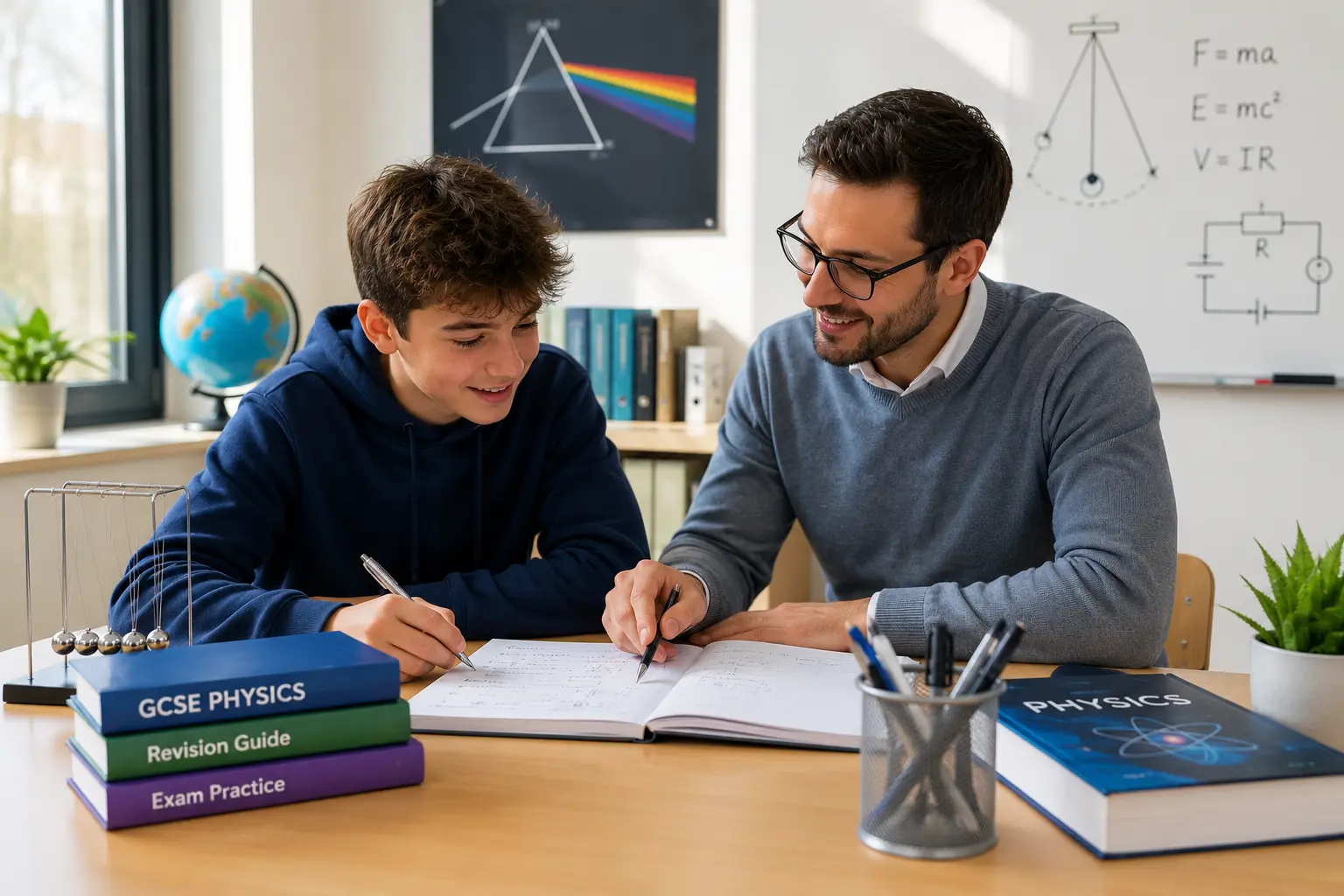
GCSE Physics sits at an interesting crossroads. It is not the hardest subject on a student's timetable in terms of content volume, but it is consistently one of the most demanding in terms of what it actually asks students to do. Apply abstract principles. Interpret unfamiliar scenarios. Rearrange formulas under time pressure. Explain physical reasoning in precise, examiner-approved language.
These are skills that classroom teaching introduces but rarely has time to develop fully. And for students in Years 10 and 11 across the UK, the gap between what is taught in class and what a GCSE Physics exam actually rewards is where grades are won or lost.
A dedicated GCSE Physics tutor closes that gap systematically, session by session, in a way that a class teacher managing thirty students simply cannot replicate. This blog explains exactly how, and why 2026 is a particularly important year for UK students to get this support right.
Before looking at how a GCSE physics tutor online helps, it is worth being honest about what makes this subject challenging in the first place.
GCSE Physics requires students to work across three distinct skill types simultaneously, and most students are stronger in one or two of them but weaker in the third:
A good online GCSE physics tutor identifies which of these three areas is weakest for a given student and builds sessions around closing that specific gap.
Physics classrooms in 2026 are better resourced than ever. Teachers are skilled, curricula are well-designed, and revision materials are readily available. Yet a persistent pattern remains: a significant number of capable students underperform in GCSE Physics exams relative to their actual ability level.
The reason is almost never a lack of intelligence or effort. It is usually one of two things. Either the student has a gap somewhere in their foundational understanding that compounded quietly over time and was never caught, or the student understands the physics when it is presented in a familiar way but loses confidence the moment an exam question presents it differently.
As explored in Jaya's Academy's blog on why mark schemes fail GCSE Physics students, this second issue is particularly widespread. Students who revise heavily using mark scheme answers often develop a false sense of preparation. They recognise familiar phrasing but struggle the moment a question changes context, structure, or wording. This is a pattern that GCSE physics tutors are trained to identify and address before it becomes a problem in the exam hall.
The first thing an experienced online GCSE physics tutor does is find out where a student's understanding genuinely stands, not where the school timetable says they should be, but where they actually are.
This means asking a student to work through problems out loud and explain their reasoning. It means listening for the misconceptions that are not obvious from a test score. A student might score 60% on a forces paper, but the reason for that score could be entirely different from what the grade suggests. They might be consistently strong on Newton's Laws but drop marks predictably every time momentum appears. Or they might understand the physics correctly but lose marks because their written explanations are vague.
Without one-on-one diagnostic work, this level of insight is impossible. With it, every subsequent session can be targeted precisely where it needs to be.
Online GCSE physics tutoring at its best does not follow the same path as a classroom lesson. A classroom lesson introduces a topic and moves on. A tutoring session stays with a topic until the student genuinely understands it - until they can explain it in their own words, apply it to an unfamiliar scenario, and answer follow-up questions without reverting to memorised responses.
This depth of understanding is exactly what the current generation of GCSE Physics papers are designed to test. AQA, Edexcel, and OCR all design questions that increasingly reward application and reasoning over recall. Students who have developed genuine conceptual clarity through online GCSE physics tutoring are significantly better placed to handle this than students who have revised predominantly through reading and highlighting.
Physics and Maths are inseparable at GCSE level. Students who struggle with formula rearrangement, unit conversion, or graph interpretation will find this creates a ceiling on their Physics grade regardless of how well they understand the concepts.
GCSE physics tutors address the mathematical dimension of Physics explicitly rather than assuming it is handled elsewhere. This means working through calculations step by step, teaching formula triangles and substitution methods, practising the specific types of mathematical reasoning that appear on GCSE Physics papers, and building the kind of numerical fluency that removes one of the most common sources of dropped marks.
For students who need additional support with the underlying Maths, the same one-on-one model applies to GCSE Maths tutoring, and many families find it valuable to have both subjects covered by a single trusted provider.
Understanding physics is necessary but not sufficient for a high grade. Exam technique - knowing how to read a question carefully, identify command words, structure a response, and present working in the way mark schemes reward - is a trained skill that develops through deliberate, repeated practice with feedback.
GCSE physics tutor online sessions at Jaya's Academy incorporate past paper questions from the very beginning of the tutoring relationship, not just in the weeks before the exam. Students work through exam-style questions regularly, receive detailed feedback on exactly where their responses are strong and where they are losing marks, and build the kind of exam instincts that only come from structured repetition under guidance.
This approach directly addresses the exam technique challenges explored in our related blog on why mark schemes fail GCSE Physics students, and the insight translates directly into more confident, better-structured answers on exam day.
In a classroom, the pace is determined by the curriculum and the teacher's need to move all students through the same material on the same timeline. In a one-on-one online GCSE physics tutoring session, the pace is determined entirely by the student's understanding.
If a student needs four sessions on electricity before the concepts are solid, they get four sessions. If they pick up thermal physics quickly and want to push into higher-tier application questions immediately, the tutor moves with them. This personalised pacing is one of the most consistent reasons individual tutoring produces better outcomes than group tuition at every ability level.
A student aiming for grade 7, 8, or 9 in GCSE Physics needs confident command across all eight major topic areas. A dedicated GCSE Physics tutor builds a structured plan that gives each area the right amount of attention:
Many GCSE Physics difficulties actually originate at Key Stage 3, not in Years 10 and 11. Students who leave KS3 with shaky foundations in forces, energy, or waves enter GCSE with gaps that quietly compound as the difficulty level rises.
If your child is in Years 7, 8, or 9, early support through KS3 Physics tutoring can prevent these gaps from forming in the first place. As detailed in Jaya's Academy's blog on the KS3 Physics curriculum explained, the KS3 years are where the habits and conceptual frameworks that determine GCSE performance are established. Getting support right at this stage is significantly more efficient than remediation later.
For students already in GCSE who feel their KS3 grounding was incomplete, an online GCSE physics tutor will typically identify these earlier gaps in the first diagnostic session and address them as part of the GCSE preparation plan.
Physics rarely sits in isolation in a student's timetable. The majority of students studying GCSE Physics are simultaneously working through GCSE Chemistry and GCSE Biology, and the demand of managing all three sciences alongside Maths and English is considerable.
Students who study all three sciences with the same tutoring provider benefit from a joined-up approach that recognises where subject content overlaps and where revision time can be used most efficiently. The scientific method, data interpretation, required practicals, and graph skills appear across all three sciences, and GCSE physics tutors who are aware of this can help students build these cross-subject skills in a way that benefits their overall science performance.
For students who may also need support in GCSE English, where written communication skills directly support the extended response questions that now appear in all three sciences, Jaya's Academy provides the same one-on-one support model across every GCSE subject.
Not all tutoring is equally effective. When choosing an online GCSE physics tutor for your child, there are several things worth prioritising:
All four of these characteristics are central to how Jaya's Academy structures its GCSE physics tutor online offering for UK students.
Students who achieve strong GCSE Physics grades and are considering continuing to AS Level Physics or A Level Physics will find that the conceptual depth and exam technique habits developed at GCSE carry significant forward value. A Level Physics is a substantial step up in mathematical demand and conceptual complexity, but students who arrive with a genuine understanding of GCSE fundamentals, rather than surface-level memorisation, make the transition significantly more smoothly.
The electromagnetic waves topic, for example, which students encounter at GCSE, becomes a considerably more mathematically demanding topic at A Level. Students who have understood the physics properly at GCSE, rather than simply memorising key points for the exam, have a real advantage when the A Level treatment of the same concepts is introduced.
Whether your child is just beginning Year 10, approaching mock exams, or heading into the final stretch of exam preparation, a dedicated GCSE Physics tutor provides the structured, personalised support that makes the difference between performing to potential and falling short of it.
At Jaya's Academy, every GCSE physics tutor online session is one-on-one, live, and built around the individual student - their specific board, their current gaps, their target grade, and their exam timeline. The same tutor works with the same student throughout the year, building the depth of understanding that drives genuine grade improvement.
Book a free consultation and demo session with our team through the contact page and give your child the support they need to achieve the GCSE Physics grade they are working toward.